
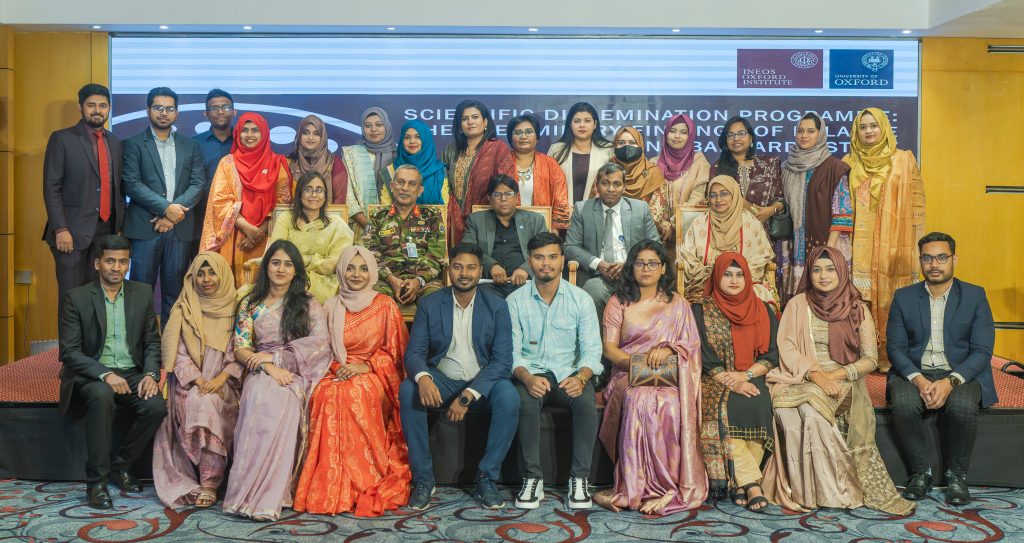
The Oxford-Bangladesh Sepsis Research Team hosted a scientific dissemination program on December 14, 2025, at Hotel Amari Dhaka to present the preliminary findings of the BALANCE and BARNARDS projects. The event was funded by the Ineos Oxford Institute for Antimicrobial Research and brought together leading clinicians, microbiologists, hospital administrators, and government representatives to discuss antimicrobial resistance (AMR) and sepsis in Bangladesh.
Both projects are led by the University of Oxford and have been implemented in collaboration with four public medical college hospitals in Bangladesh since 2022.
Opening Session and Project Overview
The program commenced with remarks from Prof. Timothy R. Walsh, Director of Biology at the Ineos Oxford Institute. Dr. Refath Farzana, Scientific Project Lead, presented an operational recap of research implementation in Bangladesh, highlighting the establishment of structured data systems and microbiology integration within public hospitals.The dissemination covered:
• BALANCE Study – Assessing the clinical and economic burden of AMR and antibiotic treatment failure in adult and pediatric bloodstream infections.
• BARNARDS Study – Focused on neonatal sepsis and antimicrobial resistance in low- and middle-income countries.
Institutional Collaboration and Microbiology Integration
A panel of directors from Dhaka, Mymensingh, and Rangpur Medical College Hospitals discussed the integration of research activities within existing hospital structures.
A technical session featuring Heads of Microbiology Departments from Dhaka, Mymensingh, Rangpur, and Khulna Medical Colleges emphasized the transition toward research-grade clinical reporting. Standardized laboratory protocols established under the Oxford-Bangladesh collaboration were highlighted as key to improving bloodstream infection detection and monitoring antibiotic resistance trends.
Key Research Findings and Policy Dialogue
Dr. Refath Farzana presented preliminary scientific findings, outlining observed resistance patterns and sepsis outcomes during the study period.
A high-level policy dialogue included representatives from the Ministry of Health and Family Welfare, Institute of Epidemiology Disease Control And Research IEDCR , and international technical partners. Discussions focused on how facility-level research can address local healthcare challenges and strengthen national AMR response strategies.
The closing remarks were delivered by Dr. Shibbir Ahmed Osman, Joint Secretary (Public Health), Health Services Division, Ministry of Health and Family Welfare, who emphasized continued institutional collaboration in combating antimicrobial resistance.
Strengthening Infection Prevention and Control
As part of the research framework, the team conducted site visits to four collaborating medical college hospitals to engage directly with Infection Prevention and Control (IPC) units. Observations from these visits informed discussions on improving hygiene practices, reducing hospital-acquired infections, and strengthening evidence-based interventions.
The event concluded with a collective commitment from participating institutions to continue collaborative research efforts aimed at improving sepsis management and antibiotic stewardship in Bangladesh.